
Every Financial Trap Sabotaging Your Retirement Plans
Fifteen ordinary decisions that quietly wreck a pension, sorted into the ones that keep you broke, the ones that keep you stuck, and the ones that keep you working. Plus the three to fix first.
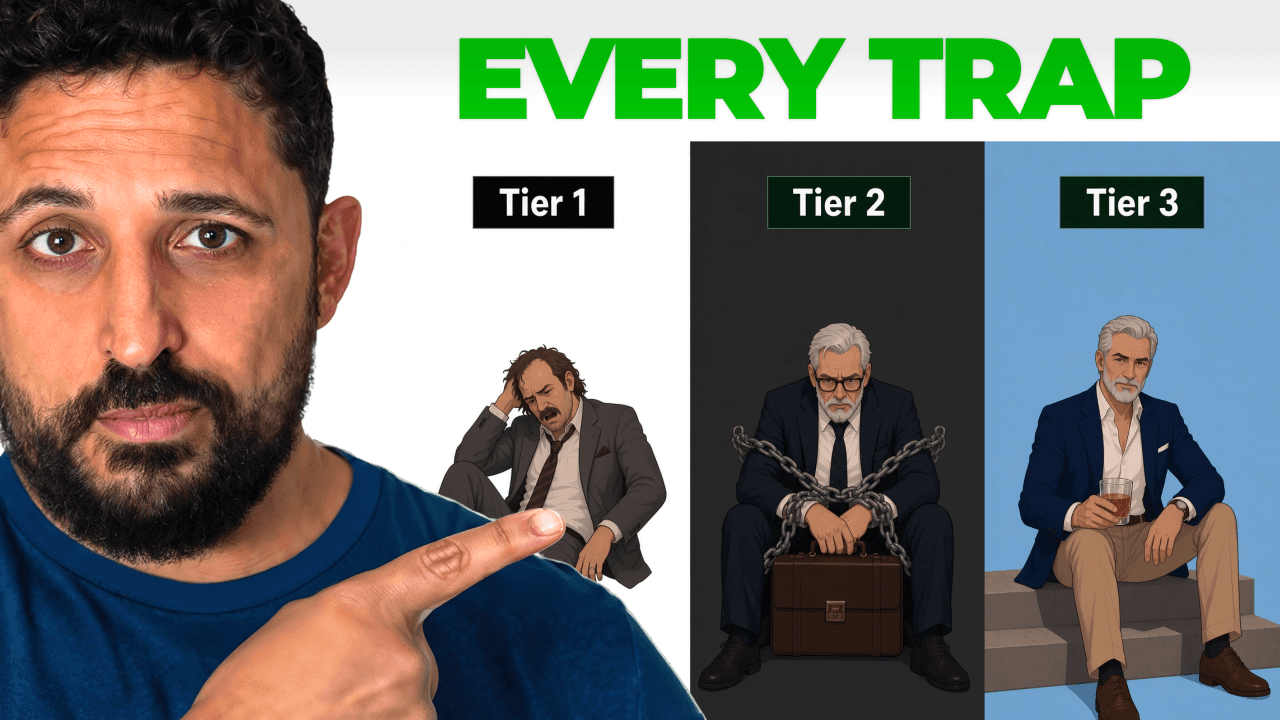
Most aspiring retirees lose their pensions through ordinary decisions.
They feel fine at the time, but over time you are almost guaranteed to suffer the consequences of your actions.
How do I know this?
Let's just say I've made some of these mistakes myself.
In this letter, I'm breaking down all 15 mistakes and splitting them into 3 tiers:
- The ones that keep you broke
- The ones that keep you stuck
- The ones that keep you working long after your money should have set you free
At the end I'll tell you which 3 to fix first.
Let's get it.
Tier 1: Traps That Keep You Broke
1. Lifestyle creep
This is one of the most common traps I see people fall into.
It's when every pay raise you get, your spending rises to match it.
Your boss gives you a pay rise?
"Let's upgrade our car."
You receive a work bonus?
"Let's spend it all on a holiday."
You naturally earn more every year and keep none of it.
The fix: save half of every raise, and make sure it's the first thing you do.
2. Assuming nothing breaks
In life, things happen.
I've had a month before when I had to fix the car, fix the boiler and pay for the dentist.
It was an expensive month, but I had an emergency fund to cover it.
Most people don't have a safety net, so they put it on the credit card, which becomes years of interest payments.
The fix: save 3 months of bills before anything else.
3. The minimum payment illusion
People in debt often settle for "the minimum payment".
This is the lowest amount a borrower must pay toward their credit card or loan balance.
It's low enough to feel affordable but high enough to keep you paying interest for a decade.
For example: a £3,000 balance at minimum payment takes 15 years to clear.
The fix: pay a fixed amount above the minimum, even if it's only £50.
4. The car payment treadmill
When people finish paying off their car loan, they often trade it in for a newer car and take on fresh debt.
It's known as a "trade in", where you roll old debt into a longer new loan.
The payment drops, the term stretches, and you never own a car.
The fix: drive your car until it's paid off, then keep driving it.
5. House poor
This is when the bank offers you the biggest mortgage you can technically afford and you take it on.
The problem is that the mortgage payment is only part of what a house costs.
Property taxes, insurance, repairs and maintenance come on top, and the bank didn't include any of that in their offer.
So a payment that looked manageable on paper leaves you with nothing spare every month.
The fix: keep your total housing costs under 30% of what you take home, no matter what the bank offers you.
6. Keeping up appearances
You finance a lifestyle to impress people who are financing theirs.
Everyone in debt is performing for an audience that doesn't actually care about you.
People find this hard to admit, but more of us do it than we admit.
The fix: admit it. Then, before any big purchase, ask if you'd still want it if nobody could see it.
7. The convenience leak
I call this "the modern trap".
Everyone I know has fallen for this at least once.
Delivery fees, forgotten subscriptions, premium versions of ordinary things.
Alone these unnecessary expenses are too small to notice, but together they can cost thousands per year.
The fix: open last month's bank statement and cancel everything you forgot existed.
Tier 2: Traps That Keep You Stuck
8. Delaying the start
Waiting for a better salary to start investing sounds sensible on paper.
But it's the most expensive mistake on this list.
The years you wait mean you're missing out on decades of compounding.
£200/month from age 25 beats £400/month from age 40.
The fix: start investing this month with whatever you've got.
9. The side hustle trap
Your spending gets out of control, so you pick up extra work to cover it instead of cutting back on expenses.
Now you're working evenings plus weekends, so you're exhausted, and the overspending that caused the problem hasn't changed.
The extra money comes in and disappears into the same habits.
The fix: cut the overspending first. Extra income only builds wealth once your spending is under control.
10. Whole life insurance
Whole life insurance combines life insurance and an investment account in one product.
The salesman tells you it protects your family and grows your money at the same time.
What he doesn't mention is the fees. The commissions and charges inside these products eat most of the investment returns, which is why they pay salesmen so well to push them.
The fix: buy basic term life insurance, which is a fraction of the price, and invest the money you save yourself.
11. Tax inefficiency
Over your lifetime you'll pay more in tax than on your house, your cars and your kids combined. Yet most people spend more time planning a holiday than planning their tax.
Governments give you accounts where your investments grow tax-free, like ISAs in the UK or a 401k and Roth IRA in the US.
Every year you don't use them, you volunteer to pay tax you could have legally avoided.
The fix: fill your tax-free accounts first, before investing a single pound or dollar anywhere else.
12. Overconcentration
This is when one investment grows so much it becomes most of your portfolio.
Usually it's shares in the company you work for, or a stock that went up so much you can't bring yourself to sell it.
It feels like winning, but it's actually a risk.
If that one company has a bad year, your entire retirement will suffer.
People who held their whole pension in Enron or Lehman Brothers stock felt like winners too, right up until the companies went bust.
The fix: keep any single investment under 10% of your portfolio. When a winner grows past that, sell some and spread it out.
Tier 3: Traps That Keep You Working
13. Overconfidence from early success
When you're winning from a couple of good years in a rising market, you feel like a genius.
But even a blind monkey could make money in those market conditions.
So you put more of your capital into the market right near the top.
The market crashes and you lose 50% of everything.
The fix: track your returns against the index (in stocks it's the S&P 500). If you're not beating it, buy the index.
14. Asset rich, cash poor
This is when nearly everything you own is tied up in your house and your pension. On paper you're wealthy. In reality you can't spend any of it.
The house money only becomes real if you sell and move somewhere cheaper.
The pension money is locked away until retirement age.
So you can be sitting on £800k of wealth while struggling to find £5k for an emergency.
The fix: build a pot of investments outside the house and pension, in accounts you can actually withdraw from whenever you need to.
15. Working too much
At some point your investments start earning more per year than your job does.
Most people never notice when they cross that line, so they keep working the same hours out of habit.
The whole point of building the money was to buy back your time.
The fix: work out what your portfolio grows by in an average year. If that number is bigger than your salary, working more is optional.
Start With These 3
Now you're probably thinking:
"I'm stuck in a lot of these traps and don't know where to start."
As promised, I'll try to make this decision easier for you.
Here are the most important 3 to tackle first:
- The convenience leak, because you can recover money instantly without making a major sacrifice.
- The minimum payment illusion, because debt compounds against you faster than investments compound for you.
- Delaying the start, because every month you wait is investment growth you never get back.
All of these traps are simple to fix, but they will hold back your dream future if you don't take action to stop them.
Count how many traps you're caught in now.
Then slowly but surely start climbing out.
Get the next one
One newsletter a week. No hype, no crypto, no leverage.